
Essential Post-Operative Rehabilitation Strategies
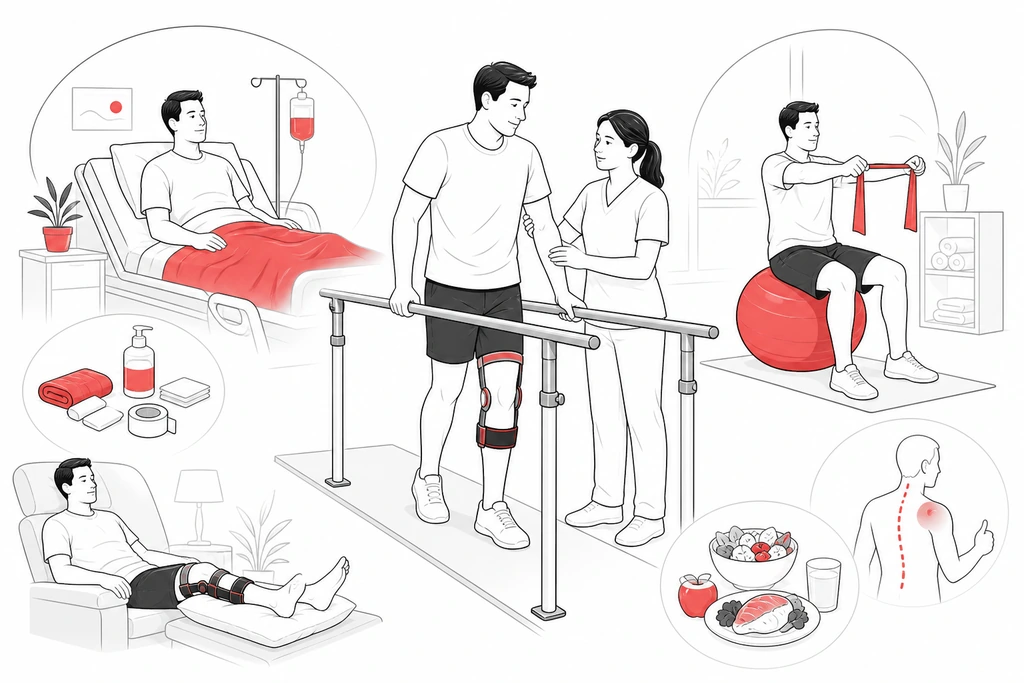
Navigating recovery after surgery requires a structured approach that balances rest with early movement. Implementing essential post-operative care and physical rehabilitation strategies helps manage early inflammation, protect healing tissues, and restore function safely. Here, you will find practical guidance on the critical first days, safe mobilisation techniques, pain management, and nutritional support to help you regain your independence steadily.
Why the First 72 Hours Matter
The surgical wound closes in the operating theatre, but the biological clock of recovery begins immediately. During the first 72 hours, the body runs three concurrent processes: haemostasis, the inflammatory response, and early granulation tissue formation. Mismanaging this critical sequence can delay the entire recovery timeline by weeks. The initial priorities are unglamorous yet vital. Keep the dressing dry and intact for the exact interval specified by your surgical team, typically 48 to 72 hours for adhesive films and absorbable sutures. Elevate the operated limb above the level of your heart for 20 to 30 minutes every two hours to limit dependent oedema. Perform active ankle pumps or gentle isometric calf contractions hourly; these movements support venous return and significantly lower the risk of deep vein thrombosis, which typically peaks between day two and day ten following major orthopaedic interventions.
Mobilisation Starts Before Discharge
Modern clinical pathways no longer wait for the patient to feel entirely ready before movement begins. Enhanced recovery protocols place supervised mobilisation within the first 24 hours for most lower-limb arthroplasty and abdominal cases. Early weight-bearing preserves lean muscle mass, supports intra-articular joint nutrition, and shortens the overall hospital length of stay by roughly one to two days. Before leaving the facility, a qualified physiotherapist normally confirms four functional competencies: transferring independently from a bed to a chair, walking 10 to 20 metres with the appropriate prescribed gait aid, negotiating one standard step, and accurately demonstrating the home exercise routine. Skipping this thorough functional assessment is where preventable readmissions frequently begin. Medical interventions such as compression stockings and prescribed anticoagulants belong to the exact same protective package; active ambulation complements them but should never replace pharmacological prophylaxis. Always request clear, written discharge instructions covering weight-bearing restrictions, joint-specific precautions, dressing change schedules, and the date of your first outpatient clinic appointment. Integrating digital-health-tools-and-telemedicine into your recovery plan helps clinicians monitor early mobility progress remotely before hospital discharge.
Progressive Loading Explained Simply
healing has actually occurred at the cellular level. Ligament and tendon repairs typically regain roughly 20% to 30% of their original tensile strength at three weeks, 50% to 60% by six weeks, and up to 80% by six months. A rehabilitation programme that completely ignores these biological healing windows is merely guesswork disguised as clinical discipline. The correct sequence remains consistent across most orthopaedic repairs: protected passive range of motion, followed by low-angle isometric contractions, concentric work against gravity, eccentric loading, and finally speed and proprioceptive retraining. Each subsequent stage advances only when the previous level produces no more than mild, transient soreness lasting under 24 hours. A practical rule of thumb is to increase training volume or external resistance by approximately 10% per week, but never increase both simultaneously. Track your training repetitions, sets, and perceived exertion scores on a standard 1 to 10 scale; a session rated at 7 should still leave the target joint feeling calm and manageable the following morning.
Recovery Essentials and Rehabilitation
Critical priorities during the first seventy-two hours
Early mobilisation protocols before hospital discharge
Nutritional support and sleep for tissue repair
Overdoing It in Week One
The most expensive beginner error in recovery is not laziness; rather, it is misplaced enthusiasm applied at the wrong physiological moment. A patient feels noticeably better on day five, postoperative swelling has decreased, and the strong temptation arises to double the exercise dose, attempt flights of stairs, and prematurely abandon compression stockings. Twenty-four hours later, the knee or shoulder becomes hot, effused, and significantly stiffer than it was on discharge day. This setback occurs because fragile, newly formed capillaries and immature collagen fibers were loaded far beyond their structural tolerance, triggering an unwanted restart of the inflammatory cycle. Such setbacks typically persist from two to ten days, and occasionally longer. The correct remedy is mechanical rather than moral. Return to the last well-tolerated exercise level for 48 consecutive hours before attempting any new progression. Reinstate limb elevation and targeted cryotherapy sessions lasting 15 to 20 minutes each, and only advance once swelling has completely plateaued for two straight days.
Key Principles of Post-Operative Recovery and Rehabilitation
| Recovery Phase | Core Clinical Priority | Actionable Strategy | Potential Risk |
|---|---|---|---|
| First 72 Hours | Manage acute inflammation and wound integrity | Keep dressings dry and elevate operated limb | Delaying healing through premature wound exposure |
| Pre-Discharge | Initiate early functional mobilisation | Practice safe transfers and basic movement patterns | Developing stiffness from prolonged immobility |
| Week One | Balance activity with tissue healing | Use pain as biological feedback for limits | Overdoing exercise and aggravating fresh tissue |
| Cellular Repair | Support structural tissue rebuilding | Prioritise adequate sleep and high protein intake | Impairing recovery through poor nutrition and rest |
Pain as Feedback, Not Failure
Pain experienced during physical rehabilitation functions as biological feedback regarding load, timing, and tissue state; it is never a definitive verdict on your overall progress. A highly useful clinical framework separates post-surgical discomfort into three distinct patterns. Sharp, catching pain during a movement that forces you to immediately stop the repetition signals restricted joint range or excessive resistance. A dull, aching sensation that appears two to four hours after exercise and fades completely overnight is generally acceptable. Conversely, soreness that persists well beyond 24 hours, disrupts your sleep at night, or grows progressively worse day after day indicates that the therapeutic dose was simply too high. Numerical scales help quantify this response: rate your pain from 0 to 10 at rest, during active movement, and on the following morning. This comprehensive three-point profile outperforms any single rating metric. A sustained rise of more than two points above your established baseline lasting over 24 hours serves as a standard clinical trigger for regression.
Sleep, Protein and Tissue Repair
Surgical wound healing is metabolically expensive, and the essential raw materials arrive exclusively through proper daily nutrition. Collagen synthesis requires approximately 1.2 to 1.5 grams of dietary protein per kilogram of body weight daily during the initial weeks following surgery. Therefore, a 75-kilogram adult requires roughly 90 to 110 grams of protein spread evenly across three or four meals rather than concentrated heavily at dinner. Essential micronutrients like Vitamin C, zinc, and adequate daily hydration support this exact same connective tissue pathway. Patient appetite frequently drops following general anaesthesia and opioid administration, making practical dietary measures—such as smaller, frequent food portions, prioritized protein at breakfast, and targeted oral nutrition supplements—far more effective than relying purely on willpower. Deep sleep is the physiological state where human growth hormone pulses and the vast majority of tissue remodelling occur.
Red Flags That Need a Phone Call
Standard rehabilitation plans always assume a predictable, normal biological recovery trajectory. However, a specific set of clinical findings falls entirely outside that normal range and warrants immediate, same-day contact with your surgical team rather than waiting for a scheduled follow-up review.
- New calf pain, localized swelling, or warmth in one leg, especially when accompanied by sudden unexplained breathlessness, strongly suggests deep vein thrombosis or pulmonary embolism.
- Surgical wound edges separating unexpectedly, cloudy or foul-smelling discharge, or skin redness spreading more than two centimetres past the original incision line.
- A persistent body temperature exceeding 38 degrees Celsius lasting for more than a few consecutive hours.
- The onset of new numbness, progressive muscle weakness, or severe pain that no prescribed medication manages to touch.
- Sudden chest pain, or a plaster cast that suddenly becomes overly tight, cold, or completely numb.
These critical symptoms are fortunately uncommon, but they are undeniably time-sensitive in nature.