
The Psychology of Healing
Physical recovery is rarely a matter of biology alone. Exploring the psychology of healing reveals how emotional stress and sustained anxiety directly alter physiological tissue repair by elevating cortisol and restricting immune function. This page examines the profound impact of empathetic witnesses, structured emotional support, and peer environments on patient resilience and clinical outcomes.
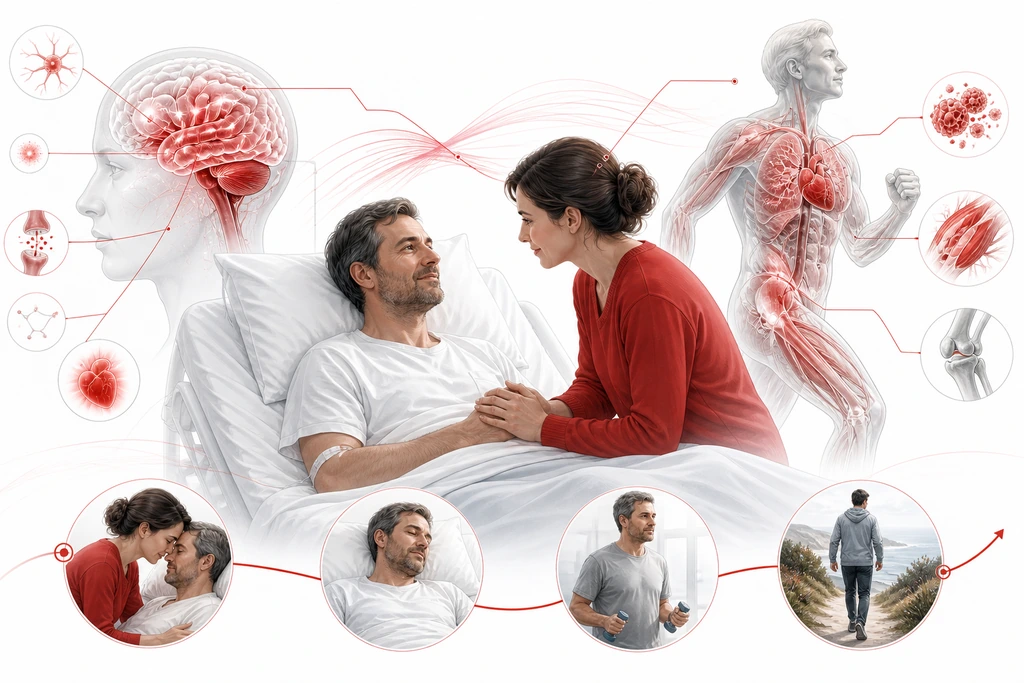
Emotional Factors in Tissue Recovery
| Recovery Parameter | Psychological Influence | Observed Timeline |
|---|---|---|
| Surgical incision healing | High preoperative anxiety elevates cortisol | Delays of up to several days |
| Inflammatory phase progression | Sustained stress hormone release | Suppressed across weeks of hospitalization |
| Small vessel constriction | Anxiety induced physiological restriction | Persistent during high stress states |
| Collagen deposition speed | Reduced immune and cellular activity | Slowed throughout recovery period |
Steps in the Psychology of Healing
-
Reduce Preoperative Anxiety Levels
Lowering fear prevents the HPA axis from triggering excessive cortisol release, which otherwise constricts blood vessels and directly suppresses the early inflammatory phase required for tissue repair.
-
Introduce Calm Emotional Witnessing
Having a steady, non-judgmental presence helps downregulate a patient's nervous system. This social buffering alters pain perception and reduces physiological stress during recovery.
-
Engage Active Empathetic Listening
Caregivers must avoid superficial cheerleading that invalidates pain. True emotional support acknowledges distress without toxic positivity, fostering genuine psychological safety.
-
Connect With Peer Support Groups
Shared experiences in peer groups normalize recovery setbacks and reduce isolation. This community dynamic alters neurochemical responses and accelerates coping mechanisms.
-
Track Emotional Recovery Metrics
Quantify psychological progress alongside physical vitals. Using specific behavioral and emotional scales helps clinicians adjust support strategies as healing unfolds.
-
Align Psychological and Medical Care
Integrate emotional interventions directly into the hospital discharge plan. Treating psychological resilience as a vital clinical variable speeds up overall tissue regeneration.
Stress Hormones Stall Tissue Repair
A surgical incision heals at a speed the body negotiates, not the one a discharge plan assumes. Fear activates the HPA axis. Cortisol rises, and the same hormone that mobilises glucose for escape also suppresses the inflammatory phase that rebuilds tissue. Studies of wound healing report delays of up to several days in patients with high preoperative anxiety compared with calmer cohorts. The mechanism is not mystical. Cortisol constricts small vessels in the skin, dampens neutrophil activity, and slows collagen deposition. Short-term, that is tolerable. Sustained across weeks of hospitalisation, it compounds into infections, wound dehiscence, and longer stays. Here the psychology of healing stops being a soft topic. Emotional state becomes a physiological variable, as measurable as blood pressure. Teams that treat reassurance as optional leave a recovery gap on the table. The evidence cuts both ways: brief, structured pre-operative conversations reduce distress and shorten hospitalisation by roughly a day. No specialist is required. Timing does most of the heavy lifting.
Why a Witness Changes Pain
Pain is not a pure signal from tissue; it is a construction the brain assembles, and company alters that assembly. Imaging work shows that holding a hand during a painful stimulus lowers activity in the anterior insula and amygdala. Skin conductance falls too. Subjects rate identical shocks as less unpleasant. The effect has a name — social buffering — and a chemistry, with oxytocin and endogenous opioids implicated in clinical studies. Crucially, the buffer is not generic. A calm companion blunts the response. An anxious one amplifies it, a finding replicated across paediatric and adult samples. Presence alone is inert; regulated presence works. This is why a nurse who sits down for ninety seconds before a dressing change can reduce analgesia demand more than a hurried reassurance delivered from the doorway. The patient's nervous system reads the visitor's nervous system before any word is spoken. Breathing rate and vocal pitch carry the verdict faster than words do.
Levers in the Psychology of Healing
Four variables reliably move recovery, and all four are modifiable by ordinary staff behaviour.
- Perceived control — patients who choose meal times, walk routes, or analgesia schedules report less distress and, in orthopaedic cohorts, mobilise sooner.
- Self-efficacy — belief in one's capacity to complete rehabilitation predicts adherence better than the severity of the initial injury.
- Expectation — the placebo literature is blunt: what a patient believes will happen shapes opioid consumption and nausea rates.
- Belonging — isolation raises mortality risk in cardiac patients to a degree comparable with smoking.
None of these requires a psychologist on the ward. They require rotas that allow continuity, language that names choices, and information delivered before fear consolidates. Continuity deserves emphasis: a patient seen by nine clinicians in nine days cannot build perceived control, because nobody holds the plan. The psychology of healing, read this way, is an operational discipline rather than a bedside sentiment. Measure the four, change the four, watch length of stay follow. Understanding the the-psychology-of-habit-formation allows patients to replace maladaptive coping mechanisms with restorative daily routines that support physical recovery.
FAQ on Emotional Recovery
How does the psychology of healing affect physical tissue repair after surgery?
What happens to stress hormones when a patient experiences genuine emotional support?
Why do peer groups play a vital role in the psychology of healing?
Cheerleading Instead of Listening
Here is the error that shows up on almost every ward. A patient says the scan frightened them. Someone answers: stay positive, you've got this. It feels kind. It is not. Forced optimism tells the patient their fear is unwelcome, so they stop reporting it — and unreported fear is untreated fear. The failure is subtle: staff who would never ignore a rising temperature will ignore a rising despair, mistaking silence for coping. Beginners also confuse reassurance with information. 'Don't worry' is a verdict. 'Here is what the scan showed and what happens next' is data, and data reduces uncertainty, which is often what the fear was made of. Researchers who study the psychology of healing repeatedly find that validation — naming the emotion without immediately correcting it — increases disclosure and adherence. Cheerleading decreases both. The fix is unglamorous. Ask one open question. Wait through the pause. Then answer the question actually asked, not the prepared script.
What Peer Groups Actually Change
Peer support is sold as a cure for isolation; the trial data is more modest and more specific. In type 2 diabetes, structured group programmes lower HbA1c by roughly 0.3 to 0.8 percentage points — clinically real, smaller than a good drug, cheaper than most. In HIV care, peer navigation improves retention in treatment, with the largest gains among patients newly diagnosed and those who had dropped out. Mental health mutual-aid groups reduce loneliness scores reliably, though not symptom severity in every study. Composition matters more than enthusiasm. A group dominated by one storyteller suppresses quieter members. Mixed-prognosis groups can frighten the newly diagnosed. Matching by stage of illness tends to outperform open formats. Facilitators who enforce turn-taking and time limits raise attendance. And there is a ceiling: peer support complements clinical care, it does not replace it. Groups that drift into advising on medication doses become a liability. Set boundaries early to ensure safe patient outcomes.
Numbers That Track Emotional Recovery
Sentiment is hard to audit; scores are not. Three instruments cover most needs. The distress thermometer takes under a minute and flags who needs a conversation today. PROMIS anxiety and depression short forms give validated, comparable numbers with four to eight items each. HADS remains standard in oncology and cardiology because it avoids scoring physical symptoms as emotional ones. Add two behavioural markers — rehabilitation session attendance and unplanned readmissions — and you have a dashboard that responds within weeks. Two cautions apply. First, these tools screen; they do not diagnose, and a score is not a referral. Second, repeated questioning becomes its own burden, so track trends quarterly rather than weekly. Where teams collect this properly, the psychology of healing stops being an argument and becomes a chartable trend line. Emotional markers must be treated as clinical data alongside blood pressure and mobility for optimal care.